
In Cameroon, high school students spend years preparing for their baccalauréat, a high-stakes final exam that can determine access to higher education and future employment opportunities. Preparing for it requires substantial time and financial resources, including tuition and paid tutoring, yet pass rates have historically been low, with only approximately 60% passing in 2019.
In the final months before the exam, students study independently at home instead of attending classes. This lack of structure can make it difficult for students to access practice exam material, collaborate with other students, identify areas requiring further study, and maintain consistent study habits.
In collaboration with the PICHNET NGO, Cameroon Ministry of Youth and Civic Education (Minjec), and local teachers, we developed a digital tool to make these learning opportunities available beyond the classroom without requiring access to computers or Internet connectivity.
Developing a cloud-based practice exam application via SMS and WhatsApp.
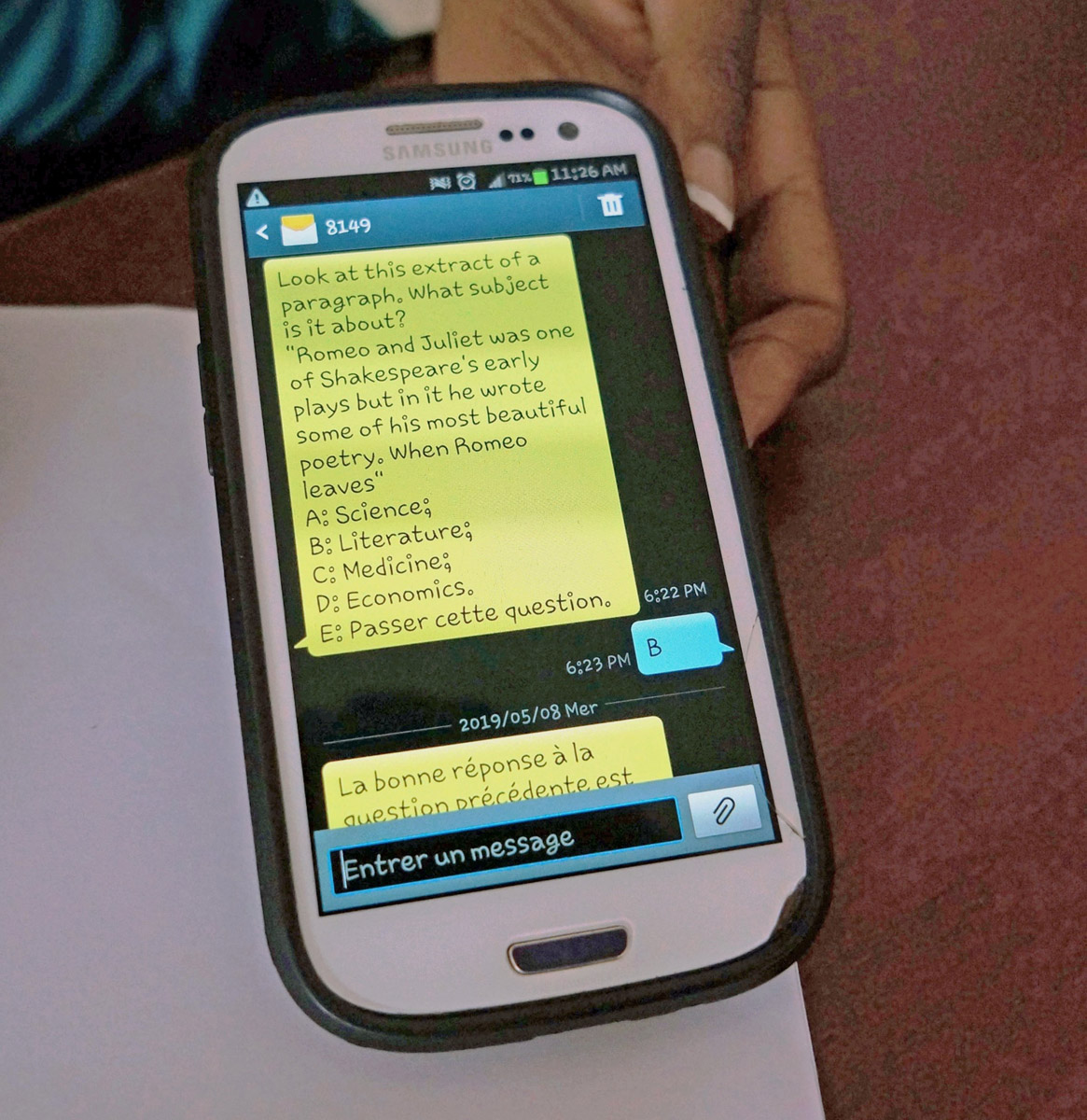
An example of an English comprehension question on the practice exam application.
We developed a practice exam application which regularly sent multiple-choice questions to students on a range of baccalauréat subjects. Students received four questions per week, with answer feedback delivered the following day and weekly performance summaries.
We developed a distributed, cloud-based workflow and integration service that delivered these quizzes directly to students’ mobile phones. The application supported both SMS and WhatsApp so students could participate without needing a dedicated learning application or smartphone. Interoperability with messaging gateways proved to be a significant implementation challenge. For SMS, we needed to identify and integrate with a gateway that could provide toll-free SMS responses on a registered shortcode. At the time, WhatsApp did not offer official programmatic integration, so we used a third-party web service that automated the WhatsApp Web interface.
A core challenge was building a reliable service that could manage scheduled quiz questions, receive student responses, and maintain the state of multi-step interactions across a large number of students. Because the application relied on messaging, we built our workflow to handle potential failures to send messages, long delays between messages, and unexpected or unstructured messages. We leveraged Amazon DynamoDB to create an application that was resilient to single server failures, but this also meant monitoring propagation delays and ensuring a consistent understanding of the quiz workflow state for each student between service instances.
Deployment and impact on learning behaviors.
We deployed the practice exam application with over two thousand students across nearly two dozen schools over the course of two years in Yaoundé. We used a mixed-methods approach to evaluate the project, including usage patterns, exam pass rates, and focus groups with students and parents.
The findings showed the practice exam application supported formative self-assessment, helped students recognize gaps in their knowledge, and prompted discussion and collaborative learning between students and their relatives and friends.
- In partnership with PICHNET and the Cameroon Ministry of Youth and Civic Education (Minjec).